
The Markings of Time: Exploring the Precision, Regulation, and Testing of Mechanical Watches
I. What Does “Precision” Mean? The Heartbeat of a Timepiece
Precision in watchmaking is typically expressed as the “daily rate” or “daily deviation,” referring to the number of seconds a watch gains or loses over 24 hours. However, these standards vary:
- Chronometer Certification (COSC): The Contrôle Officiel Suisse des Chronomètres tests movements in five positions and at three temperatures. To earn certification, a watch must maintain an average daily rate between -4 and +6 seconds, a benchmark for high-volume, premium movements.
- Top-Tier Standards: Brands like Rolex and Patek Philippe impose even stricter requirements. Rolex’s Superlative Chronometer guarantees accuracy within ±2 seconds per day, while the Patek Philippe Seal demands -3/+2 seconds per day.
- Real-World Performance: Laboratory results don’t always mirror wrist performance. Factors such as the wearer’s activity, the watch’s resting position overnight, exposure to magnetic fields, and temperature fluctuations can all influence timekeeping.
II. Regulating the Soul: The Watchmaker’s Art of Precision
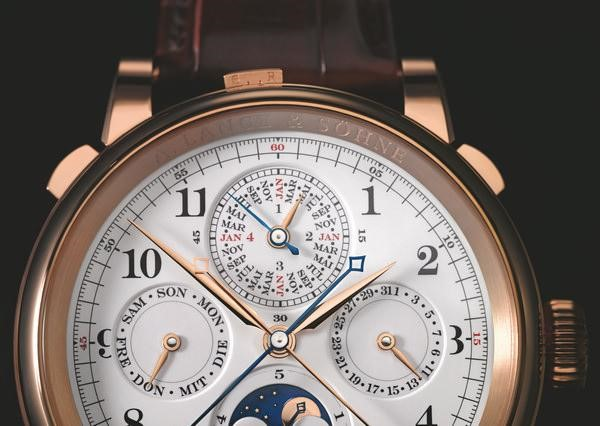
Even the most sophisticated movements demand careful adjustment after assembly to achieve peak performance. This delicate process—rooted in skill, intuition, and experience—is known as the art of precision regulation.
Core Components of Regulation
- Balance Wheel and Hairspring: Often called the “heart” and “soul” of the movement, their ability to maintain isochronism—consistent oscillation periods across varying amplitudes—is essential for accuracy.
- Regulator vs. Free-Sprung Balance:
- Regulator (Index): The traditional approach, where the effective length of the hairspring is altered by moving the regulator.
- Free-Sprung Balance: Common in modern high-end movements, this design eliminates the regulator. Instead, precision is achieved by adjusting the balance wheel’s inertia using inertia blocks or timing screws on its rim, offering greater stability and finer control.
Dimensions of Fine Regulation
- Positional Adjustment: A watch runs differently in various positions (dial up, dial down, crown up, etc.) due to gravity’s influence on the balance and hairspring. The watchmaker must test and harmonize these positions to minimize rate variation.
- Isochronism Tuning: Ensures consistent timekeeping whether the mainspring is fully wound or nearly depleted, despite changes in balance amplitude.
- Temperature Compensation: Metal components expand and contract with temperature, affecting hairspring elasticity. High-end movements counter this with special alloys like Nivarox or intricate bimetallic balance wheels to neutralize thermal effects.
III. The Scientific Verdict: Listening to Time’s Heartbeat
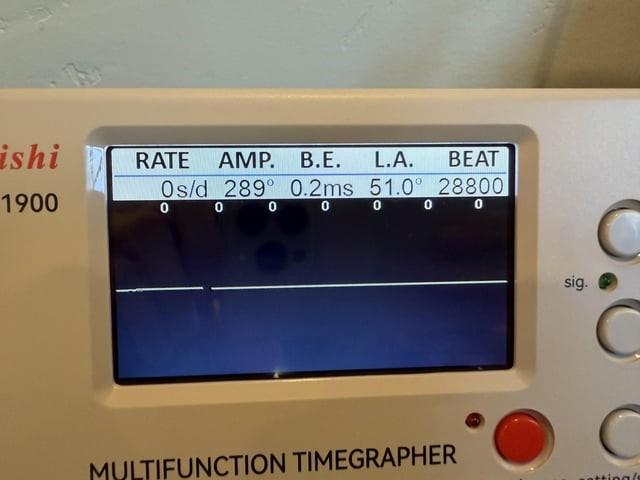
Modern watchmaking has evolved beyond the seasoned ear of a master craftsman. Today, acoustic timing machines—also known as watch rate analyzers—serve as the indispensable “eyes” and “ears” of precision.
How It Works
A sensitive microphone captures the rhythmic “tick-tock” of the movement, converts it into a soundwave graph, and calculates the interval between ticks. From this, the machine provides real-time data on critical parameters such as daily rate, amplitude, and beat error.
Decoding the Metrics
- Rate Curve: Displays the watch’s gain or loss visually.
- Amplitude: Ideally between 250° and 310°. Low amplitude may signal insufficient power; excessively high amplitude can cause “knocking.”
- Beat Error: Reflects the symmetry of the beat. A perfectly flat line is the goal.
- Sound Diagram: Reveals subtle issues like gear train friction or escapement irregularities.
Testing is performed across multiple positions and simulated power states to create a comprehensive performance map of the movement.
IV. The Ultimate Test: From Lab Bench to Wrist
Even a perfectly regulated watch must endure rigorous dynamic and real-world testing:
- Six-Position Testing: Long-term accuracy checks in fixed positions.
- Magnetization Resistance: Exposure to strong magnetic fields to verify anti-magnetic properties.
- Simulated Wear: Machines mimic daily wrist motion to test stability under dynamic conditions.
- Real-Life Trials: Many top-tier brands require testers to wear the watch for weeks, recording performance in everyday scenarios for final fine-tuning.
Conclusion: Between Precision and Poetry
The quest for ultimate precision reflects humanity’s timeless ambition to master time. Yet, the allure of a mechanical watch lies in its nature as a living machine—where slight, acceptable deviations become its unique character and breath.
Understanding the intricate regulation and testing behind a fine timepiece reveals more than technical mastery. It unveils a story of patience, ingenuity, and passion—a harmonious blend of science, art, and philosophy. This pursuit is the eternal essence of haute horlogerie.

 English
  French
  German
  Italian