
What Is a Watch Gasket? Types, Profiles & High-Performance Materials for Custom Watch Production
The cheapest part in your bill of materials decides whether the whole batch passes pressure testing. Here is how gaskets actually work, which profile belongs where, and what to put on the spec sheet before tooling starts.
FTM · Watch component manufacturing, Hong Kong
A watch gasket is a ring of engineered polymer that gets crushed between two pieces of metal. That is the entire product.
It is also the cheapest line on your bill of materials and one of the most common reasons a production batch comes back.
The formal definition: a watch gasket is an engineered elastomer or polymer sealing ring, compressed between mating case components to close a gap that machining alone cannot close. It blocks liquid water first, then everything people forget about — humidity, dust, skin oils, sunscreen, chlorinated pool water, and gas.
Here is the part that catches new brands out. Water resistance is not a component. It is a system, and five things decide whether a case passes: gasket condition, compression ratio, case machining tolerance, the crown’s double-O-ring stack, and the accuracy of the crystal seating channel. Your 10ATM rating describes the worst of those five. Not the average.
This guide covers the three profiles you will actually specify (F-Ring, O-Ring, TV-Ring), the high-performance polymers behind them (Hytrel 72D, Teflon-L, Zytel 86D), and the tolerances, QC steps and MOQs that decide what a factory can realistically build for you. Written for micro-brand founders, designers specifying a first case, and OEM procurement managers who would rather not discover any of this during the wet chamber test.
How Does a Watch Gasket Work? Compression Engineering & Tolerances
Creating a Controlled Compression Seal
Nothing in your case is flat. A CNC-machined 316L sealing face looks like a mirror and behaves like a mountain range. At the scale that matters there are peaks, valleys and tool marks. Water is very small. It finds all of them.
The gasket’s job is to become the surface the machinist could not produce. Squeeze it between two components and it deforms until it has filled every valley, then pushes back. That push-back is contact stress, and contact stress is the seal. Not the material. The pressure the material generates.
There are two ways to apply it. Axial compression squashes the ring between two parallel faces, which is what happens when a case back threads down onto the case body. Radial compression squeezes it between an inner and an outer wall, which is what happens to an O-ring on a crown tube. Different geometry, different groove design, and they are not interchangeable.
Hardness decides how the ring behaves under that load. Soft elastomers around 70 Shore A conform beautifully and forgive a mediocre surface finish. Hard engineering polymers such as Zytel at 86 Shore D barely conform at all, which is the entire point: they hold their shape under press-fit force instead of extruding out of the groove.
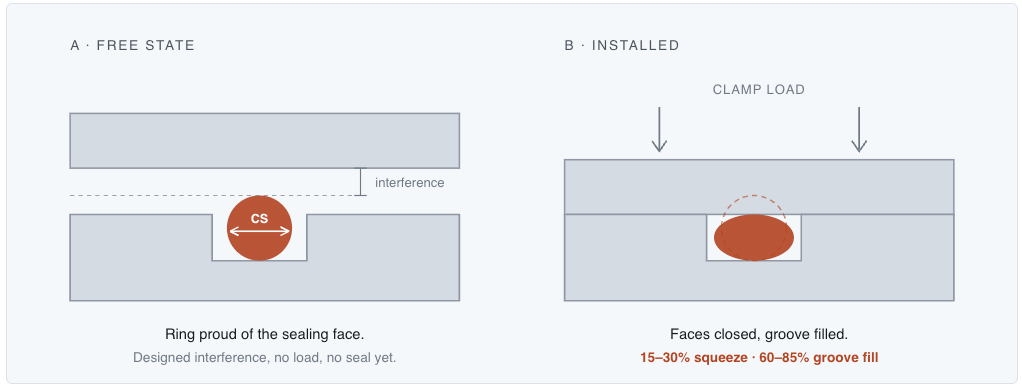
Sizing is where a cheap gasket turns expensive. As a rule of thumb an elastomeric seal wants roughly 15 to 30 percent squeeze on its cross-section and 60 to 85 percent groove fill. Below that range you have leak paths. Above it the ring has nowhere to escape and starts damaging the parts around it.
Stretching an undersized O-ring onto a crown tube looks like a fix on the bench. It is not. Stretching thins the cross-section, which reduces squeeze at exactly the moment you wanted more of it. Nobody notices until the wet chamber. Then everybody notices.
Primary Gasket Applications Across the Watch Case
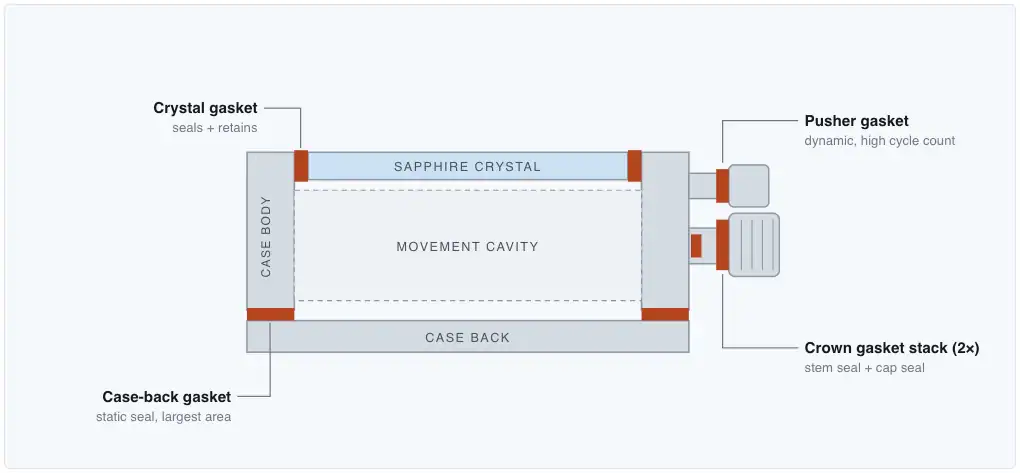
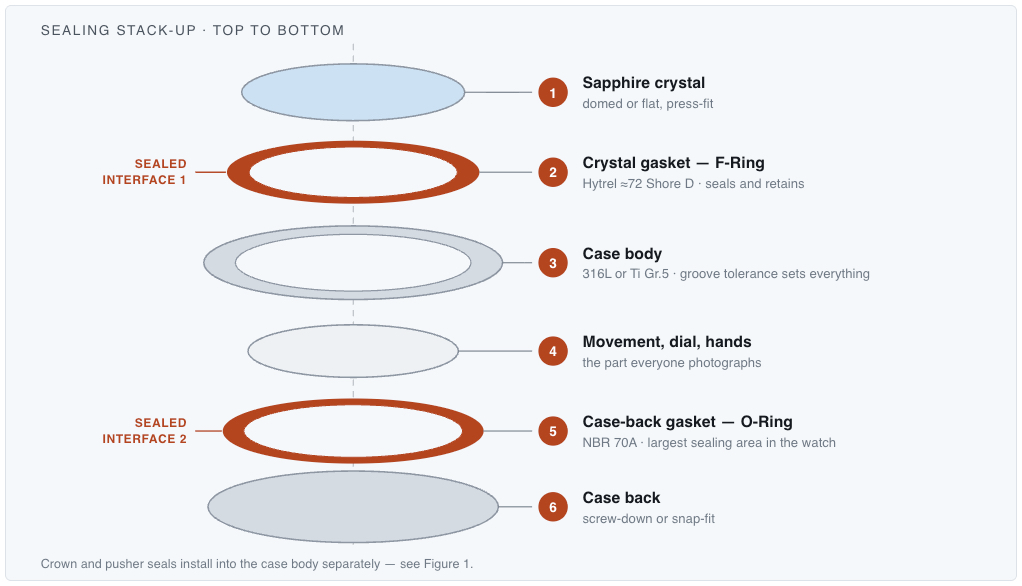
- Case-back gasket. Seals the case back, screw-down or snap-fit. Largest sealing area in the watch and the primary shield against wrist sweat, showers and hand-washing.
- Crystal gasket. Mounted between crystal and bezel or case. Needs high Shore D hardness to survive assembly force and to stop the crystal blowing out under internal pressure differential.
- Crown gasket assembly. Mounted inside the crown tube, the crown cap, or both. Subject to rotational friction and repeated stem operation.
- Pusher and chronograph seals. Small elastomeric rings actuated mechanically, under dynamic rather than static load.
Factory specification note
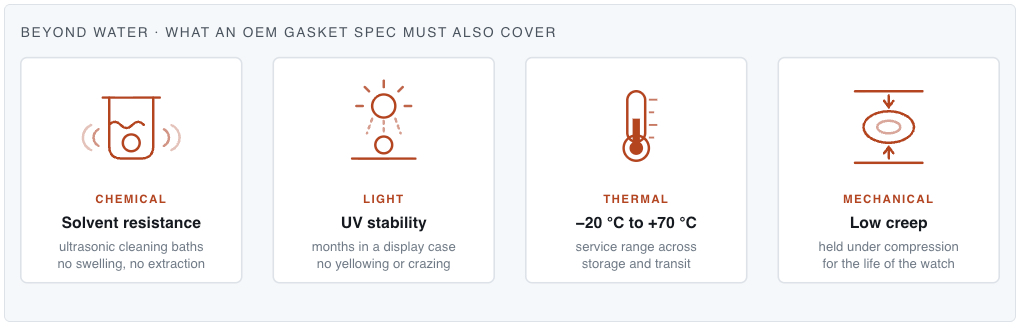
In OEM production a gasket has to do more than block water. It needs chemical resistance against ultrasonic cleaning solvents, UV resistance so it does not yellow or craze in a display case, and mechanical stability from −20 °C to +70 °C. A material that seals perfectly and then cracks after six weeks in a shop window has failed.
Watch Gasket Types by Case Application & Mounting
Case-Back Gaskets: Screw-Down vs. Snap-Fit Requirements
Screw-down case backs use a round O-ring compressed inside a precision CNC-machined channel. The threads supply the axial load; the groove decides how much of that load reaches the seal. It is the simplest, most repeatable and cheapest arrangement in watchmaking, which is why almost everyone starts here.
Snap-on and shaped cases work differently. There is no thread doing the clamping, so press-fit tension has to carry the seal. That usually means a custom rectangular, stepped or profiled gasket engineered around the specific geometry of your case back.
One habit to build early: specify case-back gaskets by groove width and cross-sectional depth, not by outer diameter. Ordering by OD alone is how brands end up with two thousand rings that technically fit and functionally do not.
Crystal Gaskets: High-Tension Structural Sealing
A crystal gasket does two jobs at once. It seals the joint, and it holds the crystal in place under tension. Get it wrong and you do not get a leak, you get a broken crystal.
Profiles cover flat, angled, chamfered, arched and double-arched geometries, matched to how the crystal edge and the bezel step are cut. Working tolerances run to roughly ±0.01 mm. A gasket 0.02 mm too thick can crack a sapphire on the press. A gasket 0.02 mm too thin sails through assembly and fails pressure testing three days later, which is worse, because by then you have built the watches.
Sapphire does not bend. It waits, and then it cracks. That single property drives most of the material decisions further down this page, and it is why custom sapphire crystal and gasket manufacturing should be quoted and toleranced as one assembly rather than two purchase orders.
Crown & Chronograph Pusher Gaskets: Dynamic Mechanical Seals
Every gasket discussed so far is a static seal. It gets compressed once and sits there for years. Crown and pusher gaskets are dynamic seals, and dynamic seals wear.
A crown gasket gets rotated, pulled out, pushed back and screwed down, thousands of times across the life of the watch. Friction is what kills it, not water. That is why screw-down crown double-O-ring assemblies are standard for 20ATM and above: one O-ring seals the stem inside the tube, a second seals the cap against the tube’s outer face. Two independent barriers, because the one that moves most is the one most likely to fail.
Chronograph pushers use miniature O-rings under repeated axial actuation. They need genuine wear resistance and the correct lubricant, usually a fluorosilicone grease. Pairing the wrong grease with the wrong elastomer causes swelling, and a swollen pusher gasket produces a mushy, sticking pusher long before it produces a leak. Customers report that as a movement fault. It is a lubricant fault.
F-Ring Watch Gasket: Stepped & Flanged Precision Profiles
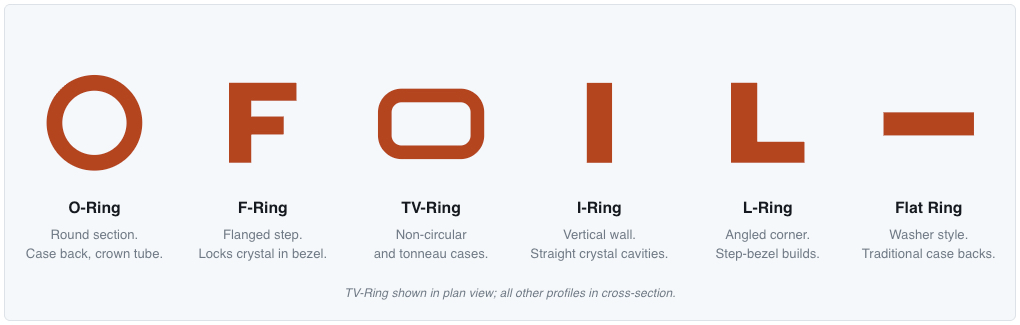
The F-Ring has a flanged cross-section cut to interlock with a specific crystal step-groove or a multi-piece case bezel. That flange gives it something no round section can offer: positive mechanical positioning. The ring cannot wander, roll or ride up while an automated press drives the crystal home.
It also puts more surface in contact with both parts, which spreads the load and reduces the chance of a stress point in the sapphire. Dive watches and multi-piece case constructions specify it for exactly that reason.
An F-Ring cannot be substituted with a standard O-Ring. The O-Ring will seal. It will not retain. Under a pressure differential the crystal has nothing holding it in, and the first thing you learn about it is in the QC report.
O-Ring Watch Gasket: The Universal Compression Seal
Circular cross-section, seals by predictable radial or axial squeeze, available in micro-dimensions from standard tooling. The O-Ring is the default for good reasons: it is versatile, cheap, well understood, and you can usually buy it without commissioning a mold.
It fails in three recognisable ways.
- Compression set. The ring goes flat under sustained load and stops springing back. Contact stress drops, and the seal quietly stops sealing while looking entirely normal.
- Environmental cracking. Ozone, UV and solvent exposure craze the surface. Common in watches that spend years in a display case rather than on a wrist.
- Twist failure. Installed with a spiral in it. Seals fine at first, then splits along the twist. This is an assembly-training problem, not a material problem, and it shows up as a scattered failure rate rather than a batch-wide one.
TV-Ring Watch Gasket: Oval & Specialized Crystal Profiles
Rectangular, tonneau, cushion and TV-screen cases have a problem that round cases do not: corners. Bend a standard O-ring around a tight radius and the outside of the section thins while the inside bunches up. Compression goes uneven precisely where the geometry is already working hardest.
The TV-Ring is molded to the case outline so that wall thickness and compression tension stay uniform through every corner. If your design brief includes the word “tonneau”, this line item is not optional and it will need its own tooling.
Other Technical Profiles: I-Ring, L-Ring, Flat & Irregular Rings
- I-Ring. A straight vertical wall retainer for crystal cavities with parallel sides. Simple section, high column strength.
- L-Ring. Angled corner profile for step-bezel constructions where the crystal seats on a shoulder rather than a flat.
- Flat gaskets. Washer-style compression seals for traditional case backs. Unfashionable, entirely effective.
- Irregular geometries. Molded or machined to match a bespoke case. If your case is genuinely original, your gasket will be too, and the tooling schedule needs to reflect that from day one.
Watch Gasket Materials Explained: Polymer & Elastomer Engineering
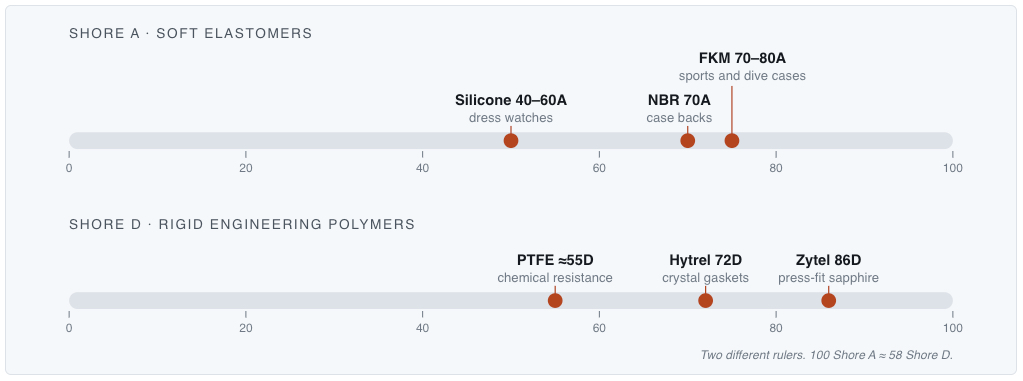
Before the material list, one clarification that saves a lot of confused emails. Shore A and Shore D are two different scales. Shore A measures soft rubbers. Shore D measures hard plastics. Roughly 100 Shore A lands near 58 Shore D, so the numbers do not compare directly. A 70 Shore A nitrile ring is about as firm as a pencil eraser. A 72 Shore D Hytrel ring is closer to a hard hat.
Hytrel: Thermoplastic Polyester Elastomer (72 Shore D)
Hytrel sits between rubber and engineering plastic and borrows the useful half of each: the flexibility of an elastomer, the strength and molding stability of a structural polymer. Rated around 72 Shore D.
What matters in production is the combination of high tensile strength, excellent flex-fatigue resistance and dimensional repeatability out of the mold. A Hytrel ring holds its specified section across a long run, so the compression you designed is the compression you get on unit 3,000, not just on the sample.
Typical use: crystal gaskets and rigid case-back step-rings, wherever the part has to provide structural support and still seal.
Teflon-L: Fluoropolymer Precision Seals
An advanced fluoropolymer blend built for two properties: near-zero friction and near-total chemical inertness. Stable from roughly −40 °C to +150 °C, which is well beyond anything a wristwatch will meet and exactly what you want for margin.
Low friction is the headline for dynamic seals. A crown gasket dies from wear, and wear is friction multiplied by cycles. Cutting the friction coefficient extends the service life of the seal without changing the crown design.
Teflon-L is supplied in colour-coded technical variants — yellow, black, natural. That sounds cosmetic. It is not. It is how an assembler confirms at a glance that the correct part is in the correct tray, which matters when three gasket types on one bench differ by 0.3 mm.
Zytel: High-Rigidity Polyamide (86 Shore D)
Zytel is an engineering polyamide, essentially a high-grade nylon, rated around 86 Shore D. Translucent to opaque, high impact resistance, and very stable dimensionally under sustained compressive stress.
Specify it where the gasket is functioning as a rigid structural lock rather than a soft seal, typically for press-fit sapphire crystals. Its near-zero creep is the property doing the work: it does not slowly relax under load, so the crystal stays exactly where the press put it.
Secondary Elastomers: NBR, FKM, Silicone, PTFE, Tefzel & Specialty Synthetics
- NBR (nitrile). The workhorse. Cost-effective, high oil resistance, entirely adequate for standard case backs. Most watches on earth are sealed with it.
- FKM (fluoroelastomer). Sold under trade names such as Viton. Roughly 70–80 Shore A, with far better solvent, ozone and compression-set resistance than nitrile. The upgrade you specify when the watch will be worn hard rather than displayed.
- Silicone. Extremely flexible across a wide temperature range and light on the case. The catch is gas permeability, so it is a poor choice where long-term internal humidity control matters. Fine for lightweight dress watches, wrong for a dive case.
- PTFE, Tefzel (ETFE) and Arnitel. Specialist polymers for aggressive chemical or thermal environments, or where an unusual friction and stiffness combination is needed.
FKM vs Silicone: Choosing the Soft Seal
FKM and silicone are the two soft elastomers that end up competing for the same jobs, and buyers ask us to compare them more often than any other pair. They are both Shore A materials, both readily available, and they fail in opposite directions.
FKM is a fluoroelastomer, usually around 70 to 80 Shore A. It shrugs off solvents, ozone, UV and skin oils, and it holds its compression set over years rather than months. That combination is close to a description of what a wristwatch actually endures: sweat, sunscreen, chlorine, a cleaning bath at service time, and constant compression the entire while.
Silicone is softer, typically 40 to 60 Shore A, and stays flexible at temperatures where most elastomers give up. It seals happily against a surface finish that would trouble a harder material. The problems are gas permeability, modest tear strength, and mediocre resistance to some oils and solvents.
| Property | FKM (fluoroelastomer) | Silicone |
|---|---|---|
| Typical hardness | 70A – 80A | 40A – 60A |
| Service temperature | ≈ −20 °C to +200 °C | ≈ −60 °C to +200 °C |
| Solvent & oil resistance | Excellent | Poor to fair |
| Ozone & UV resistance | Excellent | Good |
| Gas permeability | Low | High |
| Compression set | Low, recovers well | Moderate to high |
| Tear strength | Good | Low |
| Relative cost | High | Low |
| Best watch use | Case back, crown and pusher seals on sports and dive cases | Lightweight dress watches, cold-climate use |
For most micro-brand programmes FKM is the better default and silicone is the exception. The deciding property is usually permeability rather than anything on the pressure test: water can be kept out by either material on day one, but moisture vapour migrates straight through silicone for as long as the watch exists. If the case has to stay dry inside for years, that alone settles it.
Silicone earns its place where softness and cold flexibility genuinely matter, and where the watch will not spend its life against skin. It is also the cheaper part, which is a real argument at volume as long as you are honest about what you are buying.
OEM Sourcing, Factory QC & Quality Assurance
How B2B Brands Select & Spec Watch Gaskets
Match the gasket to the case material, not just to the drawing. Titanium Grade 5, 316L stainless and sapphire behave differently at the sealing face. Titanium is softer against a hard ring and galls more readily. Sapphire has no give at all. Steel sits between them and is the most forgiving of the three, which is one reason it remains the sensible default for a first production run. Talk this through when you scope bespoke 316L and Titanium case machining, because the case spec and the gasket spec constrain each other.
Measure four things, every time. Inner diameter, outer diameter, cross-section and groove fill percentage. A drawing that gives you ID and OD but no cross-section is not a specification, it is a suggestion.
Align the pressure rating to the whole assembly. 3ATM, 5ATM, 10ATM, 20ATM and 30ATM are the standard steps. Worth remembering that a 3ATM rating comes from a static pressure test equivalent to three bar, not from a promise about thirty metres of swimming. Your customer will never read that sentence, which is precisely why your gasket specification has to.
Coatings are part of this conversation too. A plated or coated sealing surface changes friction, hardness and finish at the exact interface the gasket has to seal against, so PVD and IP surface finish durability belongs in the same review as the gasket selection rather than after it.
Factory Quality Control Protocols for Gasket Production
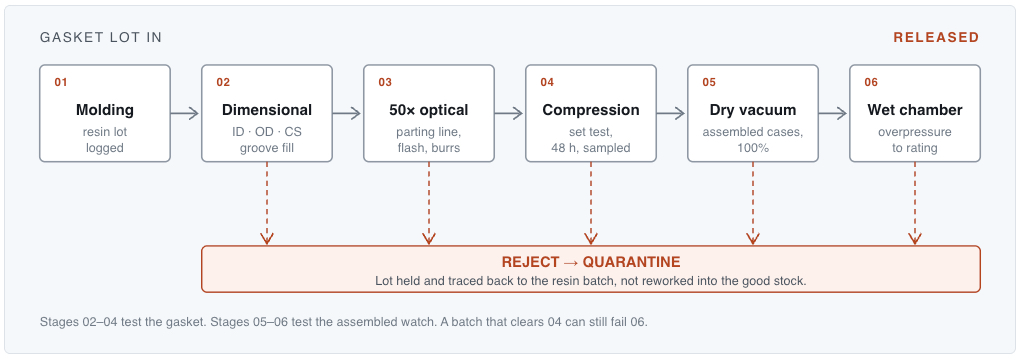
- Microscopic inspection. Gasket edges checked under 50× optical magnification for clean parting lines, free of flash and burrs. A 0.05 mm burr on a parting line is invisible on the bench and is a leak path in the chamber.
- Compression set testing. Elasticity, tensile strength and recovery verified after 48 hours under sustained compression. This is the test that predicts whether the seal still works in year three, and it is the one most often skipped.
- Pressure chamber QA. 100 percent dry air vacuum testing on assembled cases, followed by wet overpressure chamber testing. Dry testing finds the gross failures fast and cheaply. Wet testing confirms the rest.
B2B Sourcing, Tooling Lead Times & MOQ Considerations
The commercial split is simple. Standard O-Ring sizes run from existing mold dies, so you can order small and reorder quickly. Proprietary F-Ring and TV-Ring profiles need their own tooling, and tooling means an upfront cost, a lead time before first article, and an MOQ that reflects both.
Plan the tooling before the launch date, not after. A custom crystal gasket is not a part you can expedite once the cases are already machined, because the groove in those cases was cut to match a gasket that does not exist yet.
Batch-to-batch polymer consistency is the other thing worth paying for. Two shipments of nominally identical rings, molded from different resin lots at different shops, can differ enough in hardness to move your pass rate several points. Consistent resin sourcing and documented lot traceability are a large part of what Hong Kong watch manufacturing QC protocols exist to deliver, alongside export compliance and independent oversight of mainland production.
Frequently Asked Questions
What is the primary function of a watch gasket in B2B manufacturing?
It provides a compressed environmental seal between machined case components, keeping water, dust, oils and atmospheric moisture out of the movement cavity. In production terms it also absorbs tolerance: it closes the gap machining cannot close, repeatably, across a whole batch of cases rather than on one good sample.
What is the difference between an F-Ring and an O-Ring watch gasket?
An O-Ring has a symmetrical round cross-section and seals by predictable squeeze. An F-Ring has a flanged, stepped profile engineered to lock into a specific crystal groove or bezel step, so it seals and mechanically retains the crystal at the same time. Substituting one for the other keeps the seal and loses the retention.
Why is Hytrel (72 Shore D) preferred for watch crystal gaskets?
Because it is rigid enough to hold a sapphire crystal under press-fit load without deforming permanently, while retaining enough elastomeric memory to keep generating contact stress. Softer materials seal well and let the crystal move. Harder materials hold the crystal and seal poorly. Hytrel sits at the useful point between the two.
Should I specify FKM or silicone for a watch gasket?
Specify FKM wherever the seal meets solvents, ozone, skin oils or sustained compression, which covers case backs, crowns and pushers on anything sportier than a dress watch. Choose silicone only for lightweight dress pieces or a genuine cold-weather requirement. FKM costs more per piece. Silicone’s gas permeability rules it out where internal humidity has to stay controlled for years.
What are the minimum order quantities (MOQ) for custom-molded watch gaskets?
Standard O-Ring sizes can usually be sourced in runs of 300 to 500 pieces from existing tooling. Custom F-Ring or TV-Ring profiles requiring a new injection mold typically start at 1,000 to 3,000 pieces, and the tooling lead time matters as much as the quantity when you are planning a launch.
Specifying gaskets for a production run?
Gasket selection is decided by the parts around it. If you are scoping a first case or revising an existing one, the relevant component pages are crystals and gaskets, crowns and pushers, watch cases and surface treatment. As a watch gasket manufacturer we would rather see the case drawing early than the failure report late. Send it over and we will come back with the profile, material and watch sealing tolerances we would run it with.

 English
  French
  German
  Italian